


About

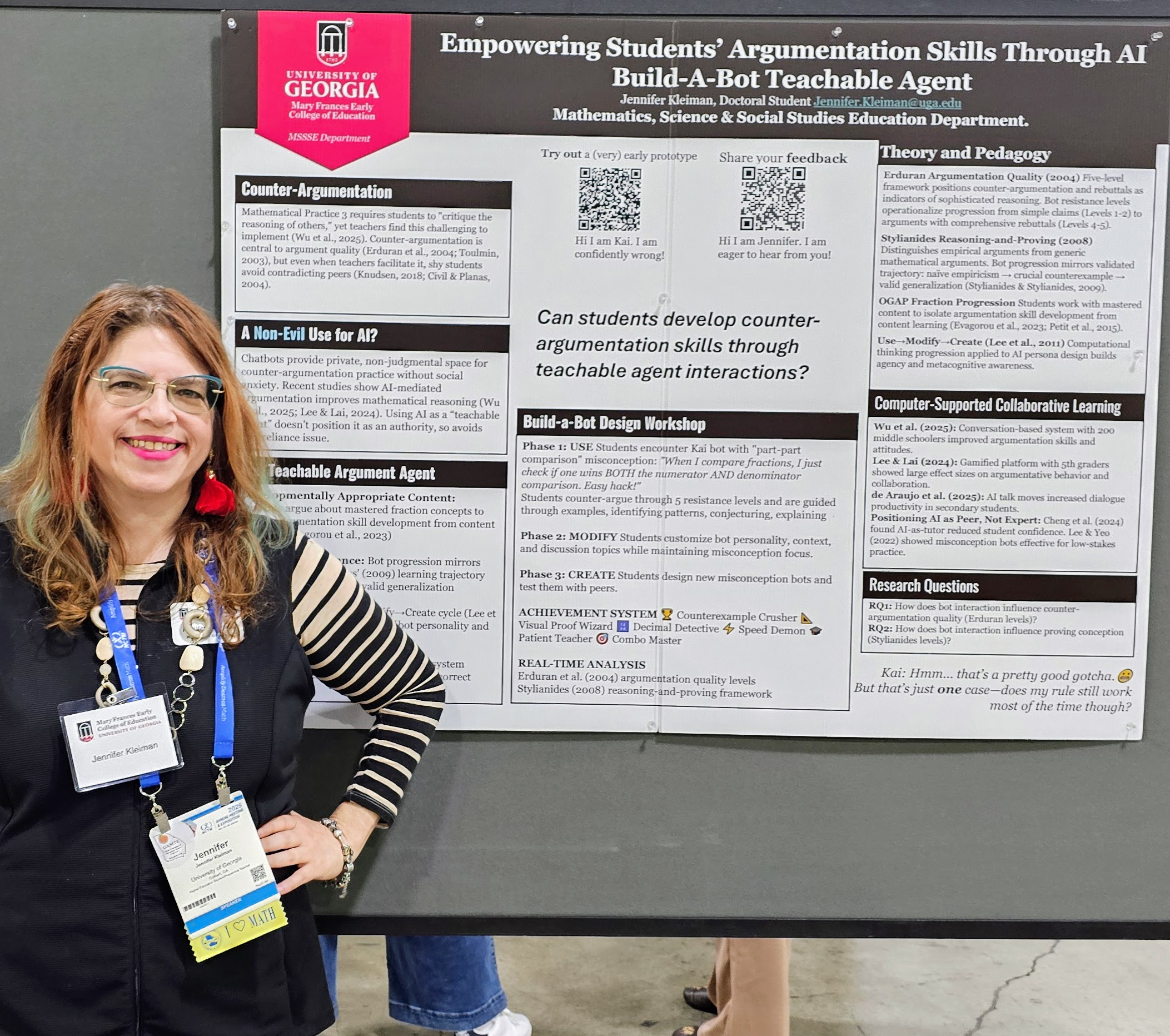
I'm 55 years old and I started my PhD in mathematics education in January 2024. I'm at the University of Georgia working on AI applications in math education, but I got here via a long detour through corporate IT, game design, and a brain surgery that clarified some things.
Why I Do This Work
I spent decades building software systems and leading IT departments. I've seen the pattern before: technology that looks impressive in demos but doesn't actually help users. AI in education is following the same trajectory. Lots of hype, lots of venture funding, lots of claims that don't survive contact with real classrooms.
I build things first, then research them. Not the other way around. I want to know if tools actually work before publishing papers about them. This makes me slower than people who just prompt ChatGPT and write up the results, but it means my research is about real tools with real students, not thought experiments.
I care about whether AI genuinely enhances learning or just looks cool. I can tell the difference because I've built both kinds of software. The cool-looking kind gets funding. The actually-helpful kind requires understanding how people learn and what makes tools usable.
How I Got Here
I was ABD (all but dissertation) in math education back in the late 90s when life intervened. My family's insurance benefits business was collapsing after the IT director quit suddenly. I put my PhD on hold to save the company, which I did - built a modern IT department from scratch, worked 80-120 hour weeks initially, eventually got it stable.
Then I got comfortable. Stayed at the company while doing minimum work. Spent my time running online guilds in strategy games, designing worlds for D&D campaigns, building game prototypes. Started a keto food company with my partner. Lost 100 pounds. Had good years living in the country, building things that interested me, not worrying much about legacy.
In 2022 I sneezed in my sleep and my skull fractured. Spinal fluid leaked out my nose for days before I figured out it wasn't a sinus infection. Emergency surgery, then more surgery at Duke to repair the cracks. When I woke up from that second surgery, my brain was running at 100%. Maybe it hadn't been for years - I don't know. But it was clear then.
I had maybe 20-30 productive years left. I could spend them coasting, or I could do work that mattered. I'd been using AI successfully in my D&D campaigns. I understood AI, computing, and math education. My niche wasn't pure AI research - too many smart people already there. My niche was the intersection: someone who could build AI tools, understand mathematical learning, and critically evaluate whether the tools actually worked.
I applied to UGA's math education program. Got in. Started January 2024. I've been killing it. No self-sabotage this time around.
Early on I took a course on reasoning and proof with AnnaMarie Conner, and we watched video of a third-grade argumentation lesson. The students who stood up and argued their case in front of the whole class were fearless. I kept thinking about the ones who stayed quiet in their seats instead.
I joined a project called C4OMS soon after, watching small groups of elementary students work through coding-integrated math tasks. In one session, the group I was observing fell apart while the teacher was busy with another group. She never made it over before one of the kids ended up crying. I watched another group try to flag her down to show off a solution and lose her attention before they could. Circulating faster isn't the fix; knowing when a group needs help is.
That's the question ArguAgent exists to answer: can an AI tell when a small group of students actually needs help, in time to matter? Building it surfaced a second problem I hadn't expected. Getting usable audio out of four kids talking over each other in a real classroom is genuinely hard. That problem now has its own line of work, VoiceLens.
What Makes My Approach Different
I'm a builder who does research, not a researcher who occasionally builds things. When I work on ArguAgent, INTRA, or VoiceLens, I'm writing actual code, debugging actual problems, making actual architectural decisions. The research comes from asking: does this tool help students learn? How do I know? What would constitute evidence?
I have low tolerance for AI hype. I've seen this movie in corporate IT: impressive demos that collapse in production. When someone claims their AI revolutionizes education, I want to see the actual classroom data. When someone says AI can grade mathematical arguments, I want to know what happens when it's wrong.
I also have low tolerance for purely theoretical work that never touches real students. There's value in theory, but I'm interested in tools that work in messy classrooms with actual middle schoolers, not idealized learning environments.
Life Outside Research
I live in rural Madison County, Georgia on 10 acres of woods and gardens with my partner Gloria. We're 20 minutes from campus, which is far enough to have quiet but close enough that I can attend seminars and meetings when needed.
I used to run D&D games constantly - multiple games a week, elaborate custom worlds like Riven (a forested realm with AI-illustrated settings), regular salons on voice chat. I had to scale back when the PhD started demanding real time. I miss it. Now that comprehensive exams are done, I need to get back to better work-life balance and start playing again.
I'm good at building communities, which turns out to be relevant for building educational tools. I ran war guilds in strategy games, organized online groups, created spaces where people wanted to spend time together. Same skills, different context.
My closest friend Ciel lives in Malaysia. We met online during COVID when I was running D&D games. He's 28 and wants to move to the US. I'm working on making that happen and navigating the immigration bureaucracy. These things take time but they're worth doing.
Little Joys
Game
Dungeon Crawl Stone Soup
Cocktail
Chocolate-cherry old-fashioned
Daily ritual
Evening walks with Gloria
Classroom project
Snackdown data visualization challenge
Past projects
Riven worldbuilding (returning after defense)
Terminal
iTerm2 with JetBrains Mono
Values
Research about tools that don't exist yet is speculation. Build it, test it with real students, then write about what actually happened.
Claims about AI capabilities need evidence. Impressive demos need classroom validation. Hype needs skepticism.
Tools should amplify student thinking and teacher judgment, not replace them. AI works best when it helps humans see each other more clearly.
Design for students on the margins. If tools work for them, they work for everyone. Math class should be a place where all students feel powerful.
Current Work
I passed my comprehensive exam defense. Two papers I was advancing since then are now out: the MKT-AI framework (PME-NA 2025) and the ArguAgent grouping paper (AIED 2026). Currently in review: a journal piece with Susan Cannon on AI and qualitative field notes (International Journal of Social Research Methodology), three AERA 2027 submissions on AI transcription methodology. The SSMA proceedings manuscript on sensing intervention opportunities in small-group argumentation has been accepted.
I'm also Co-Editor for The Mathematics Educator, which means I handle manuscripts and make editorial decisions. This has taught me what AI fingerprints look like in academic writing. I can spot undisclosed AI use now - there are patterns in structure, word choice, and how citations get deployed.
I'm starting to write on this site and engage publicly about AI in math education — what works, what doesn't, what's hype, what's real. I have opinions and I can back them up with actual built systems and actual data.
Credentials
Education
PhD, Mathematics Education — University of Georgia (2024–Present)
Advisors: Dr. AnnaMarie Conner, Dr. Xiaoming Zhai
MS, Mathematics — Purdue University (1993–1996)
BS, Mathematics — Purdue University (1992–1993)
Service
Co-Editor — The Mathematics Educator (2024–Present)
Treasurer — Mathematics Education Student Association, UGA (2024–Present)
Skills
Python, TypeScript/React, Node.js, .NET/SQL | Qualitative methods, video analysis, mixed methods | LLM integration, prompt engineering, multimodal AI | Transana, Git, various research tools